
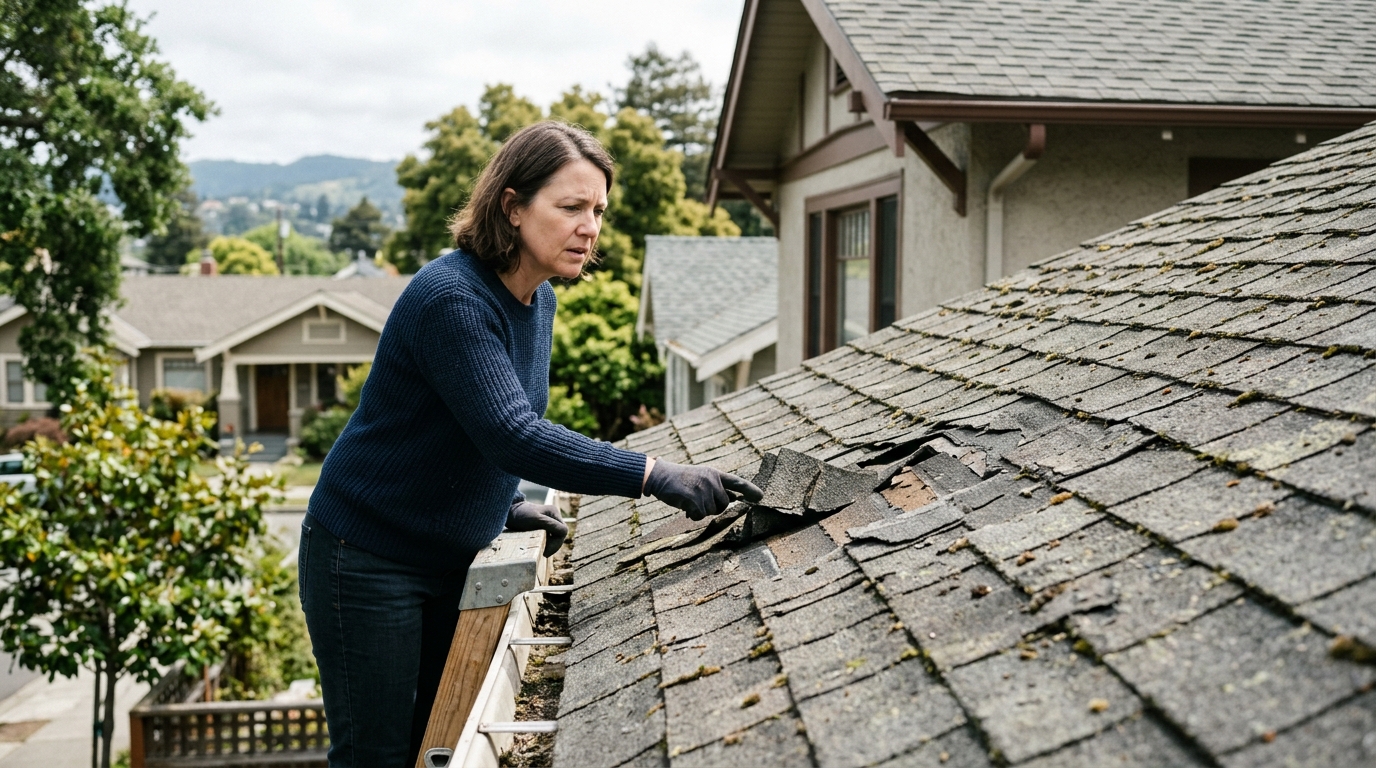
Your roof doesn’t announce its death date. It gives you years of warning first, in the form of granules in your gutters, curling edges, and a slow softness in the attic decking you only find when someone finally looks. The homeowners who wait for a ceiling stain before calling almost always end up paying more, because by then, the problem has been building for years.
We’ve been replacing roofs across Contra Costa, Alameda, and Solano counties since 1996. As GAF Certified Applicators and CertainTeed SELECT ShingleMasters, we’ve seen every version of this story. Here’s what to look for before the water gets inside.
What Your Roof Is Trying to Tell You
Roofs communicate through physical signals long before they fail. By the time you see a water stain on your ceiling, the problem has usually been building for years. The signs that matter are the ones you can spot right now, from your driveway, or in five minutes with a flashlight in the attic.
Signs You Can See From the Ground
Granules Collecting in Your Gutters
Granule loss is the most reliable physical sign of an aging asphalt shingle roof, and also the easiest to miss. Mineral granules are the UV-protective coating bonded to the surface of asphalt shingles by manufacturers like GAF and CertainTeed. A little initial shedding on a brand-new roof is normal. On a roof that’s 10 to 15 years old, consistent granule loss signals a different problem entirely.
Warning: Granule Loss Does Not Get Better
Once granule depletion starts on an aging shingle, no repair reverses it. Patching individual shingles on a roof with systemic granule loss is spending money on borrowed time. If your gutters are holding grit after a rainstorm, that is the roof telling you it is done.
When the granule layer thins, UV hits bare asphalt directly. Shingles dry out, become brittle, and crack. From the street the roof may still look fine, but the UV protection is already gone. ARMA (Asphalt Roofing Manufacturers Association) identifies granule depletion as the leading precursor to shingle failure. This is a replacement signal, not something that gets better with spot repairs.
Check your gutters after the next good rain. Granule buildup is worth a call.
Curling, Cupping, or Cracked Shingles
Shingles that curl upward at the edges (cupping) or develop surface cracks are drying out. The asphalt layer is losing flexibility. On Bay Area homes with south-facing slopes, this cycle accelerates: morning fog adds moisture, afternoon sun bakes it out. Older 3-tab shingles, common on pre-2000 homes throughout Contra Costa and Alameda counties, are especially vulnerable to this pattern.
Widespread curling across multiple roof planes points toward replacement. Isolated cracking on an otherwise sound, relatively young roof can still be repaired. The key word is widespread. When it’s systemic, patching individual shingles just postpones the same conversation.
Sagging Areas or Dips in the Roofline
No gray area here. Any visible sagging, whether you spot it from the driveway or from the street at an angle, means the decking beneath the shingles has absorbed water and lost structural integrity. The decking is the plywood or OSB (oriented strand board) substrate that shingles are nailed into. When OSB or plywood decking gets wet repeatedly over time, it compresses and softens.
Sagging is a safety and structural call, not a repair question. The right answer is roof replacement.
Moss, Algae, or Dark Streaking
The Bay Area’s marine fog and coastal moisture make moss and algae growth more common here than in most parts of the country. North-facing slopes, and anything shaded by trees or adjacent structures, can stay damp between rain events long enough for moss to take hold.
Dark streaking is typically algae. Moss is the concern. It retains moisture against the shingle surface and physically lifts the edges, creating channels for water intrusion. On a roof that’s already 15 or more years old, heavy moss growth usually means the underlying shingles have been compromised for some time. Look at the whole roof, not just the surface.
We’ve seen roofs in Berkeley and Oakland where the moss problem masked shingles that had been granule-free for years. You clean the moss and find the shingle underneath looks like bare asphalt paper.
Missing or Damaged Flashing
Flashing is the metal trim installed around chimneys, skylights, vents, and roof valleys. It’s not glamorous, but flashing failures are among the most common water entry points on Bay Area roofs. Flashing is exposed to thermal movement, water, and in coastal areas, corrosion from salt air.
Lifted, rusted, or missing flashing is a primary leak source. If you’ve had a “mysterious leak” near a chimney or skylight that’s been patched more than once, flashing is usually the explanation.
Flashing failure on an older roof typically points toward replacement: the flashing and shingles age together. NRCA (National Roofing Contractors Association) installation standards require that flashing be replaced as part of a full re-roofing system, not left in place when new shingles go over.
Signs From Inside Your Home
Take a flashlight into your attic on a dry day. You’re looking for three things.
Water Stains on Ceiling Boards or Rafters
Water stains on the underside of your roof deck or on rafters indicate water has tracked through at some point. Even if the area feels dry today, the staining tells you there’s been a breach. It may be active or it may be from a past event that was partially addressed. Either way, look at the exterior above that area.
Daylight Visible Through Roof Boards
This one is unambiguous. Any light penetrating through the roof deck means there are gaps or cracks in the structural substrate, not just worn surface material. If you can see daylight, water can find the same path.
Soft or Spongy Spots Underfoot
If you can walk your attic, pay attention to how the decking feels underfoot. Softness or give in the floor of the attic tells you the same thing as exterior sagging: the structural layer has absorbed moisture and lost its rigidity. We replaced a roof in Danville last year that looked acceptable from the street. The attic told a different story. The decking was soft in two sections and had been deteriorating for years. The homeowners had no idea.
When the attic shows soft spots or visible staining, budget the cost of decking repair into your replacement estimate. It adds to the project cost, but it also explains why the repair-only path would have kept failing.
When Age Alone Is Enough
Sometimes the only sign you need a new roof is the calendar.
By the Numbers: Bay Area Housing Stock
43 Years
The median age of U.S. owner-occupied homes as of 2024, per NAHB. Bay Area homebuilding peaked in the 1950s through 1980s. Many Contra Costa and Alameda County homes have roofs that are 25 to 30 years old, with no replacement on record.
Bay Area Factor: Salt Air Compresses Shingle Lifespan
Homes within a mile of the bay, including Kensington, Richmond, Albany, and El Cerrito, face persistent marine fog and salt air that accelerate granule loss. A 25-year-rated shingle in those locations may reach end of life at 18 to 20 years. If you live near the water, subtract a few years from the standard lifespan estimates.
The median age of U.S. owner-occupied homes reached 43 years as of 2024, per NAHB’s Eye on Housing data. Bay Area homebuilding peaked in the 1950s through the 1980s. A large share of homes in Contra Costa and Alameda counties are 40 to 70 years old. Some have had one roof replacement. That replacement may now be 25 or 30 years old.
Here’s what the lifespan data says, by material:
| Material | Practical Lifespan | Notes |
|---|---|---|
| 3-tab asphalt shingles | 20 years | Common on pre-2000 Bay Area homes; NAHB figure |
| Architectural asphalt shingles | 22-25 years standard; 30+ for premium | Current replacement standard; GAF Timberline HDZ carries lifetime limited warranty |
| Concrete or clay tile | 50-100+ years | With proper maintenance; common in Danville, Orinda, Alamo hillside neighborhoods |
| Wood shake | 20-30 years | California WUI restrictions may require Class A replacement before end of natural lifespan |
There’s also a Bay Area coastal modifier that matters. Homes within a mile of the bay, including those in Albany, Berkeley, Richmond, Kensington, and El Cerrito, face persistent salt air and marine fog that compress asphalt shingle lifespans. We’ve seen roofs in Kensington replaced at 18 years due to marine exposure, well short of the rated 25.
If you don’t know when your roof was last replaced, check the permit history through your county’s building department. It’s public record.
Repair or Replace? How to Decide
Having done this work since 1996, here’s how we think about it.
If the roof is past 60 to 70 percent of its expected lifespan and has widespread problems, replacement is more cost-effective than patching. Patching a 22-year-old asphalt roof with granule loss across multiple sections is spending money on a timeline, not a solution. You’re buying a few more years while the underlying system keeps declining.
The 25 percent rule is a standard used by NRCA and many insurance carriers: if more than 25 percent of a roof’s surface area needs repair, replacement is typically the more cost-effective path. At that threshold, the cost of materials and labor for repairs approaches replacement cost, and the whole system is usually more compromised than the visible damage suggests.
Two questions come up constantly:
“Should I replace my roof if it’s not leaking?” Yes, if the signs above are present. Active leaks are a late-stage symptom. Granule loss, curling shingles, and age are early-stage signals. A roof that isn’t leaking yet can still be at or past the end of its useful life. The roof only starts leaking after the UV protection is gone.
“How do I know if I need a new roof or just repairs?” Isolated damage on a relatively young roof is a repair. Systemic deterioration, meaning multiple signs, or one sign on a roof past 70 percent of its lifespan, is a replacement. We’ve told homeowners they didn’t need a replacement yet. We’ve also seen homeowners who waited too long and needed decking work on top of shingles. The difference usually comes down to catching it early.
If you want to understand more about what goes into a replacement system, our guide to types of roof underlayment explains the layers beneath the shingles and why they matter.
If you’re seeing two or more of these signs, it’s worth a call. Pacific Coast Roofing Service has been replacing roofs in Contra Costa and Alameda counties since 1996. We’ll give you a straight answer. (510) 912-5454.
Two Bay Area Factors That May Force Your Hand
California’s Insurance Market
California’s homeowners insurance market has tightened significantly. Carriers have restricted or paused new policies across much of the state. For Bay Area homeowners with aging roofs, this has a direct financial consequence.
Warning: An Old Roof Can Affect Your Coverage Terms
California carriers are increasingly shifting policies on aging roofs from replacement cost value (RCV) to actual cash value (ACV) at renewal. On a 22-year-old roof, ACV may pay a fraction of what replacement actually costs. A new Class A-rated roof with a documented warranty can be the difference between full coverage and a large out-of-pocket gap.
Many carriers now flag roofs older than 15 to 20 years at renewal. A roof older than 20 years may trigger a required assessment before renewal, or a shift in coverage terms from replacement cost value (RCV) to actual cash value (ACV). That distinction matters more than most homeowners realize. RCV pays what it costs to replace your roof today. ACV pays a depreciated value, which on a 22-year-old roof might be a fraction of actual replacement cost.
A new Class A-rated roof with a warranty on file can be the difference between renewing at replacement-cost terms and losing coverage. California’s Safer from Wildfires framework also offers premium discounts of 5 to 20 percent for Class A roofing in high-fire zones.
Pacific Coast Roofing doesn’t do insurance claim work. The angle here is proactive: replace before your carrier makes the decision for you.
Fire Zone Compliance in the East Bay Hills
Cal Fire’s Very High Fire Hazard Severity Zones cover significant portions of the East Bay hills, including areas of Orinda, Danville, Lafayette, Clayton, Richmond, and El Cerrito. In these WUI (Wildland-Urban Interface) communities, wood shake and untreated wood shingles are banned on replacement roofs. This is a building code requirement, not a recommendation.
Homeowners in these neighborhoods with aging shake roofs are facing two problems at once: end-of-life materials and a mandatory transition to Class A-rated roofing. A GAF or CertainTeed architectural shingle system meets that requirement and satisfies Title 24 energy code compliance for Bay Area climate zones where cool roof standards apply. More information on qualifying materials is in our fire-resistant roofing materials guide.
What to Do When You See These Signs
Pacific Coast Roofing Service has been replacing roofs across the greater Bay Area since 1996. We replace roofs 12 months a year. Rainy season is not a reason to wait.
Call Before Rainy Season Starts
If you are seeing two or more of the signs in this guide, the time to call is now, not after the first October storm. Pacific Coast Roofing Service has been replacing roofs in Contra Costa and Alameda counties since 1996. We will give you a straight answer on what you are looking at.
As GAF Certified Applicators and CertainTeed SELECT ShingleMasters, we offer up to 25 years of workmanship warranty coverage through CertainTeed’s SureStart PLUS program. Your old roof has no warranty left. A new one from Pacific Coast Roofing can have 25 years of workmanship coverage, transferable to a new owner within 15 years.
If cost is the concern, we get it. Bay Area roof replacements typically run $15,000 to $30,000 for a standard single-family home with asphalt shingles, depending on size, pitch, and complexity. That’s a real number, and we’ll give you a real quote for your specific roof.
We’re C-39 licensed through CSLB (Contractors State License Board). We carry workers’ comp and liability insurance. You’re protected from the first call.
Call us when you see these signs. We’ll tell you honestly what you’re looking at.
(510) 912-5454. Monday through Friday, 7am to 6pm. Saturday, 9am to 3pm.
Frequently Asked Questions
Should I replace my roof if it’s not leaking?
Not necessarily, but an absence of leaks doesn’t mean a roof is healthy. Granule loss, curling shingles, and age past 20 years are all early-stage warning signs that often precede leaks by years. By the time water comes through your ceiling, the problem has usually been building for a long time. If you’re seeing exterior signs of roof wear, call before the leak starts. Waiting costs more.
What is the 25% rule in roofing?
The 25% rule is a standard used by NRCA and many insurance carriers: if more than 25% of a roof’s surface area needs repair, replacement is typically more cost-effective than patching. At that point, repair costs approach full replacement cost, and the underlying system is usually more compromised than the visible damage suggests.
Is a 20-year-old roof too old?
It depends on the material and where you live. A 3-tab asphalt shingle roof, common on Bay Area homes built before 2000, has a practical lifespan of about 20 years, so a 20-year-old 3-tab roof is at the end of its useful life. Architectural asphalt shingles last 22 to 25 years under normal conditions, shorter in coastal Bay Area cities where persistent salt air and marine fog accelerate granule loss. Tile roofs can last 50 to 100 years. If you’re not sure what type of shingles you have, find out before the next rainy season.
How much does a roof replacement cost in the Bay Area?
Bay Area roof replacements typically run $15,000 to $30,000 for a standard single-family home with asphalt shingles, depending on roof size, pitch, and complexity. Some larger or steeper roofs run higher. These figures reflect Bay Area labor rates, permit costs, and Title 24 energy code requirements, which are significantly higher than national averages. The right way to know your number is a real quote for your specific roof. Call us at (510) 912-5454.