
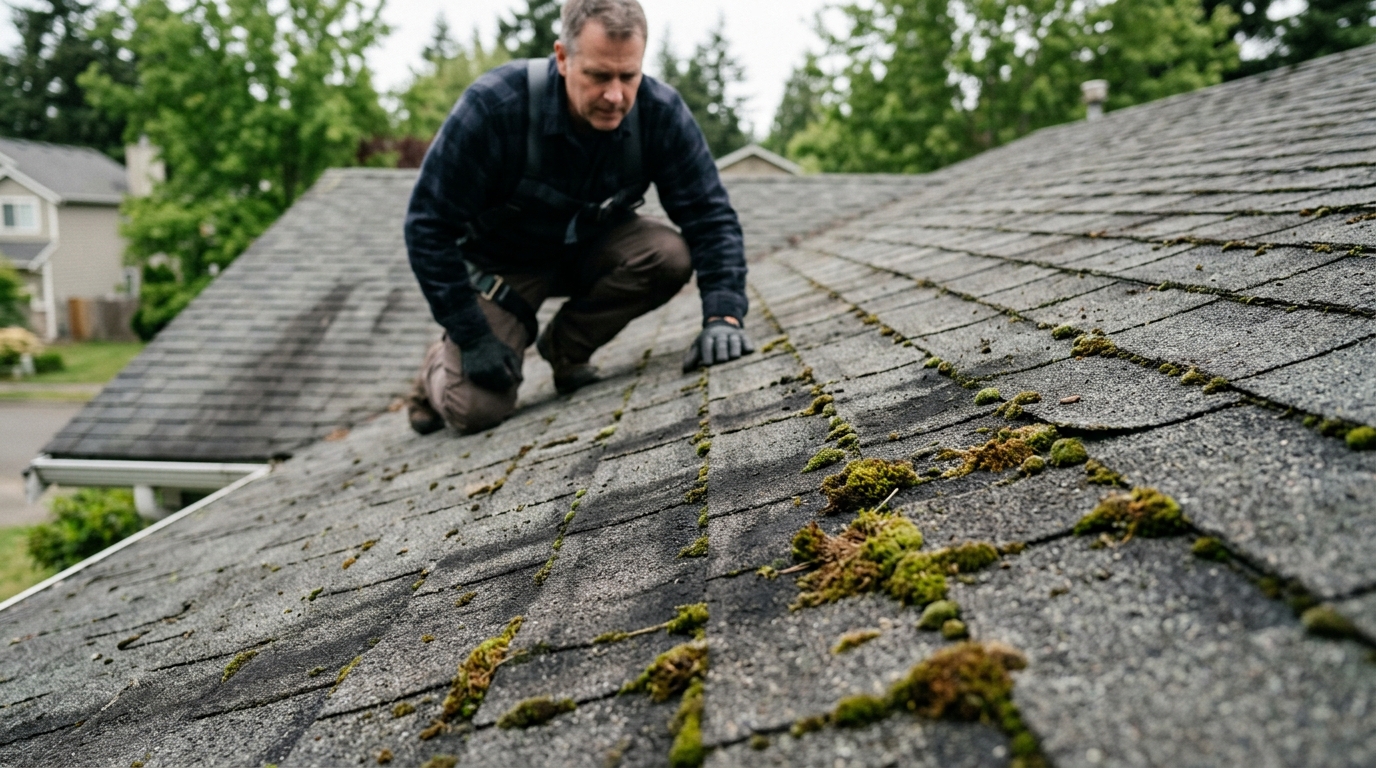
Those black streaks running down the slope of your roof are not dirt, not shadowing from nearby trees, and not normal aging. They are a living cyanobacterium. The green patch creeping along your north eave is a true plant with root structures actively working into your granule layer. What each of these means for your roof depends on three things: what organism it is, how old the roof is, and what the shingles look like underneath. Sometimes the answer is cosmetic and the roof has years of useful life left. Sometimes it means cleaning is wasted money on a roof that should be assessed for replacement. Here is how to tell the difference.
If your discoloration is not biological (rust streaks from metal flashing, tree debris staining, or fading from age), see our companion guide to the six common causes of discolored roof shingles.
Three Organisms Growing on Your Roof (and Why Each Tells a Different Story)
Most homeowners lump all of this together as “roof gunk.” Algae, moss, and lichen are three distinct organisms with three different damage profiles and three different diagnostic implications. Treating them as interchangeable leads to wrong decisions.
ℹ️ Why Black Streaks Run Downhill
Gloeocapsa magma colonies expand by following gravity. Spores travel by wind and birds, which is why entire blocks can develop streaking within one or two seasons of the first affected property. The streak color deepens as the colony ages: newer growth looks gray or faint brown; an established colony looks nearly black. If your neighbor’s roof shows heavy streaking and yours does not yet, it likely will.
Black Streaks: Gloeocapsa Magma, the Cyanobacterium Behind Most Staining
The organism behind nearly every black streak on asphalt shingles is Gloeocapsa magma, a cyanobacterium. The roofing industry calls it “roof algae,” though that label is technically a misnomer. Gloeocapsa magma feeds on the limestone filler embedded in the asphalt matrix of shingles. That limestone is its food source.
As the colony grows, it develops a dark UV-protective outer sheath around its cells. That sheath produces the characteristic black-brown streak color, deepening as the colony ages. A new colony looks gray or faint brown. An established one looks nearly black.
Streaks run downward because gravity pulls expanding colonies in one direction. Spores travel by wind and birds, which is why a whole block tends to show staining within a season or two of the first neighbor developing it.
Diagnostic note: The Asphalt Roofing Manufacturers Association (ARMA) states there is no definitive scientific evidence that algae alone is structurally damaging to asphalt shingles in the short term. Early-stage algae staining is primarily cosmetic. That said, Gloeocapsa magma retains moisture against the shingle surface and accelerates ceramic granule loss over time. Its presence is a prompt to look more carefully at the roof’s age and overall shingle condition, not a reason to panic.
Moss: The Bryophyte That Physically Lifts Shingles
Moss is a different category of problem entirely. Unlike algae, which grows flat against the shingle surface, moss builds three-dimensional structure on top of and between shingles. It is a true plant (a bryophyte), and it anchors itself using tiny root-like structures called rhizoids that drive into the granule layer and physically displace ceramic granules. That is direct mechanical damage. ARMA is explicit: “Unlike algae, moss can be detrimental to asphalt shingle performance.”
The second problem is moisture retention. A dense moss mat acts as a sponge, holding water against shingle surfaces for days after rain or fog. In Bay Area winters, moss-covered shingles on a north-facing slope may stay wet for weeks between rain events, softening the asphalt matrix and creating conditions for granule separation.
The third problem is shingle lifting. Moss growth pushes under the leading edges of shingle tabs, gradually lifting them. Once tabs are lifted, water runs under them rather than over them. The shingle is no longer shedding water the way it was designed to.
Diagnostic note: Visible moss with lifted or curling shingle tabs on a roof over 15 years old is a replacement assessment conversation, not a cleaning conversation.
Lichen: The Fungus-Algae Partnership That Usually Signals Replacement
Lichen is a symbiotic organism: a partnership between fungi and algae living as a single structure. It appears as crusty, flat patches on the shingle surface, typically gray, white, or yellow-green, with a texture unlike either moss or algae streaks.
The key characteristic is how lichen bonds to the surface. Lichen forms root-like structures that penetrate below the granule layer and chemically bond with the shingle material beneath. The International Association of Certified Home Inspectors (InterNACHI) specifically identifies lichen as a cause of granule detachment and reduced shingle lifespan. When lichen is removed, granules come with it. Dead lichen continues to hold its bond for months. There is no safe method for removing established lichen from asphalt shingles without causing surface damage.
Diagnostic note: Lichen on a significant portion of the roof means the shingles underneath are already permanently scarred. No treatment restores them. If lichen has established itself widely, the conversation is about replacement timing, not cleaning.
The Number That Changes Everything: Your Roof’s Age
A moss-covered 8-year-old roof and a moss-covered 22-year-old roof are not the same problem. One is a maintenance question. The other is a replacement question. Age is the single most important variable in this diagnosis.
⭐ The 15-Year Rule
Once a Bay Area asphalt shingle roof crosses 15 years, biological growth stops being a cleaning question and becomes a replacement question. Architectural shingles rated for 25 to 30 years often show end-of-life characteristics at 20 to 22 years in coastal and fog-belt environments. If the roof is in that window and showing moss or lichen, a replacement assessment is the right call before spending money on cleaning.
| Roof Age | Organism Present | What It Means |
|---|---|---|
| Under 10 years | Algae (Gloeocapsa magma) only | Soft-wash cleaning is a reasonable option. Monitor granule condition. |
| Under 10 years | Moss or lichen | Address now. Have a roofer examine shingle tabs and granule integrity. |
| 10-15 years | Any organism | Evaluate granule condition before spending money on cleaning. If granule loss is significant, cleaning extends cosmetics but not lifespan. |
| 15-20 years | Any organism | Replacement assessment warranted regardless of organism type. Architectural shingles in Bay Area coastal conditions typically reach end of life in this window. |
| 20+ years | Any organism | The roof has likely reached the end of its design life. Staining is a symptom, not the primary issue. |
Bay Area coastal and near-coastal conditions shorten these windows. Architectural shingles rated for 25-30 years often show end-of-life characteristics at 20-22 years in high-moisture, fog-belt environments, where repeated wetting cycles from the marine layer accelerate granule separation and asphalt degradation.
How to Read Severity Without Getting on the Roof
Before anyone spends money on anything, a homeowner can do a reasonable severity assessment from the ground, or carefully from a ladder at the eave, without walking the roof.
💡 The One Check You Can Do Right Now
After the next rain, look at your downspout outlets. Granule loss shows up as coffee-ground-like grit collecting at the base of downspouts or in your gutter corners. This is the clearest DIY signal of significant shingle wear. You do not need to get on the roof to find it. If the grit is there in noticeable amounts, that is a sign the shingles have lost meaningful surface protection regardless of how clean or stained they look from the street.
Stage 1: Surface Staining Only
- Streaks or moss are visible, but shingles appear flat and intact from ground level
- No visible bald patches (dark areas where granules have washed away)
- Gutters after rain: minimal grit or sandy residue at the downspout outlets
This is likely cosmetic or early-stage, particularly on a roof under 15 years old. Gloeocapsa magma staining at this stage has not yet compromised the ceramic granule layer.
Stage 2: Active Damage Indicators
Signs the roof has moved past cosmetic:
- Granule buildup in gutters: Coffee-ground-like grit collecting at downspout outlets after rain. This is the most actionable DIY check a homeowner can do, and it is the clearest signal of significant granule loss from the shingle surface.
- Visible bald patches: Dark areas where ceramic granules have washed away, visible from the ground with binoculars or from a neighbor’s vantage point.
- Shingle tabs curling upward at the edges, particularly on slopes where moss rhizoids have been active.
- Staining on all slopes, not just the north-facing one. Widespread biological colonization across the roof surface means the shingles are not shedding moisture effectively from any direction.
At Stage 2, cleaning removes the organism but does not restore the granule layer. The shingles’ remaining protective function is already reduced regardless of how clean the surface looks afterward.
Stage 3: Structural Concern
Signs that moisture has moved past the shingle surface and into the roof system below:
- Ceiling stains or water marks inside the attic or top-floor rooms
- Soft or spongy spots when walking on the roof (this is deck rot: the plywood or OSB sheathing has absorbed moisture and begun to fail)
- Visible daylight through the roof deck when looking up from inside the attic
Stage 3 is not a cleaning situation. Deck rot means the sheathing beneath the shingles requires replacement in addition to the roof system above it. In the Bay Area, that added scope is a significant cost difference.
If you are seeing Stage 2 or Stage 3 signs, the next call to make is to a roofing contractor, not a cleaning company.
Why Bay Area Microclimates Accelerate Biological Roof Growth
Every article about black streaks and moss was written for a generic US audience. None account for the Bay Area’s specific environment, which is one of the highest-risk markets in California for biological roof growth.
The USGS Pacific Coastal Fog Project documented summertime fog in Bay Area coastal and near-coastal zones averaging 2 to 6 hours per day, derived from more than 30,000 hourly satellite images over nine summers from 1999 to 2009. That marine layer fog is not just atmospheric moisture. It deposits liquid water directly on shingle surfaces. A property in the fog belt can have wet shingles for 8 to 10 hours on a summer morning without a single drop of rain falling.
Repeated wetting and partial drying, day after day from June through September, creates conditions where Gloeocapsa magma and moss colonize asphalt shingles year-round.
Specific high-risk zones in our service area:
Berkeley Hills and Oakland Hills. Marine layer fog combined with oak, eucalyptus, and redwood canopy. Properties on west-facing hillsides receive the densest marine fog directly off the Bay. North-facing slopes on these properties can stay damp almost continuously through winter, sustaining moss growth between storms.
Kensington and El Cerrito. Hillside properties with dense tree cover and fog frequency nearly identical to the Berkeley Hills. Many homes here are on their second or third roof system, built on 1950s and 1960s housing stock.
Orinda and Lafayette foothills. Shielded from direct marine fog by the East Bay hills, but significant winter rainfall and heavy redwood and oak canopy. Moss prevalence is high because of sustained wet winters and persistent organic debris accumulating on roof surfaces.
Canyon-facing properties in Contra Costa. Redwood canopy deposits acidic needle debris that holds moisture and creates pH conditions favorable to moss colonization. Properties in Walnut Creek, Danville, and San Ramon foothills with heavy tree cover show similar patterns to the Oakland Hills.
North-facing slopes stain and develop moss first because they receive the least direct sunlight and stay wet longest after rain or marine fog. In most Bay Area homes, the north-facing slope is the back of the house: less visible, less monitored. Homeowners often find significant growth on the back slope that has been advancing for two or three seasons before they notice it.
What Pressure Washing Does to Your Roof
Homeowners frequently consider pressure washing as a DIY solution. ARMA’s position is direct: “Do not use a power washer or any type of brush or broom to clean algae from the roof surface. High-pressure washing systems are likely to damage asphalt roofing and should not be used to remove algae or for any other purpose.”
⚠️ Before You Rent a Pressure Washer
The Asphalt Roofing Manufacturers Association is explicit: high-pressure washing is likely to damage asphalt roofing and should not be used for any purpose on a roof. At 1,500 PSI or more, a standard residential pressure washer blasts ceramic granules off the shingle surface permanently. Granules do not reattach. Most manufacturer warranties are voided on contact. If a cleaning company shows up with a pressure washer, that is the wrong tool for the job.
Standard residential pressure washers operate at 1,500 PSI or more. At that pressure, they blast ceramic granules off the shingle surface permanently. Granules do not reattach. Most manufacturer warranties, including those from GAF and CertainTeed, are voided by pressure washing. The result: pressure washing may remove visible staining while simultaneously stripping the granule layer that gives the shingle its UV protection and fire resistance.
The ARMA-approved method is soft washing: a diluted bleach solution applied at low pressure, with 15 to 20 minutes of dwell time, then rinsed with low-pressure water. This kills organisms without granule damage. Pacific Coast Roofing does not offer this service. But knowing what correct cleaning looks like is worth understanding before hiring someone to wash a roof.
When Cleaning Is Wasted Money
Pacific Coast Roofing does not offer roof cleaning. That means we have no financial incentive to tell you cleaning is a bad idea when it is not. This section is the honest version of that conversation.
Two situations where cleaning may not make economic sense:
Bleach treatments are temporary. Organisms return in as few as 9 months in high-moisture environments. The bleach kills existing growth but does not change the underlying conditions that allowed it: north-facing exposure, tree shade, marine layer fog, and the limestone filler in the shingles that Gloeocapsa magma feeds on. Annual or biannual cleaning cycles represent a recurring cost for a problem that only stops when the shingles are replaced with algae-resistant materials.
Cleaning an aging roof is cosmetic, not curative. A 20-year-old roof with algae staining and granule loss in the gutters has one problem you can see (staining) and one problem you cannot (reduced shingle integrity from granule depletion and asphalt degradation). Cleaning addresses the visible one. It does nothing for granule depletion, microscopic cracking in the asphalt matrix, or shingle tabs that have begun to lose their sealing adhesive. The roof’s remaining useful life is the same after cleaning as before. The surface just looks better.
For a roof in its last few years of functional life, cleaning is money that could go toward a replacement.
The Permanent Answer: Algae-Resistant Shingles
When a stained roof reaches replacement age, there is a meaningful upgrade available. Algae-resistant (AR) shingles contain copper granules that leach copper ions with each rain event. Copper is naturally algaecidal. At sufficient concentration, copper ions make the shingle surface inhospitable to Gloeocapsa magma and moss colonization.
GAF StainGuard Plus is available on Timberline series shingles. GAF distributes copper microsites throughout the ceramic granule layer; these release copper ions gradually during rain. StainGuard Plus carries a 25-year limited warranty against blue-green algae discoloration, with 10-year non-prorated coverage. The premium Timberline UHDZ carries StainGuard Plus PRO, extending the warranty to 30 years. Pacific Coast Roofing is a GAF Certified Applicator.
CertainTeed StreakFighter is CertainTeed’s copper-granule technology. The Landmark Pro carries a 30-year StreakFighter warranty. Landmark ClimateFlex carries 25 years.
For a Bay Area property with a history of algae returning every one to two years, the marginal cost of AR shingles at replacement directly offsets the cleaning cycle that would otherwise continue indefinitely. Pacific Coast Roofing has replaced East Bay roofs for over 30 years and has seen this pattern repeatedly: homeowners who clean a chronically staining roof get the same staining back inside a season.
Signs It Is Time for a Replacement Assessment, Not a Cleaning Quote
Call a roofing contractor about replacement when any of the following apply. Any two or three together is a strong indicator.
🎯 Seeing Two or More of These Signs?
That is not a cleaning situation. Pacific Coast Roofing offers free replacement assessments for Bay Area homeowners. We have been replacing roofs across the East Bay and beyond since 1996, and we have no interest in selling you a replacement you do not need. A 20-minute assessment tells you where the roof actually stands.
- The roof is 15 years or older and showing any biological growth
- Moss is present and shingle tabs are lifting or curling
- Lichen is present on a significant portion of the surface
- Granule grit is accumulating in gutters after rain
- Staining has appeared on all slopes, not just the north-facing one
- The roof is showing algae or moss for the second or third season after prior cleaning
- Any interior signs appear: ceiling stains, attic soft spots, or visible daylight through the deck
Pacific Coast Roofing offers free replacement assessments. If the roof is showing these signs, a call to (510) 912-5454 is the right next step.
Frequently Asked Questions
What are the black streaks on my roof called?
The organism behind most black streaks on asphalt shingles is Gloeocapsa magma, a cyanobacterium. The roofing industry commonly calls it “roof algae,” though that is technically a misnomer. Gloeocapsa magma feeds on the limestone filler in the shingle asphalt and develops a dark UV-protective outer sheath that creates the characteristic black-brown streak color. It spreads via airborne spores and reproduces rapidly in moisture-favorable conditions, particularly on north-facing slopes with tree shade.
Is it bad if there is moss on my roof?
It depends on the roof’s age and how established the moss is. On a newer roof with early-stage growth, moss is manageable with the right treatment. On a roof over 15 years old, or one where moss has lifted shingle tabs or built up in thick mats, it is a structural concern. Moss holds moisture against the shingle surface and uses rhizoids to physically displace ceramic granules from the shingle surface. Left unaddressed on an aging roof, moss accelerates granule separation and can wick moisture into the roof deck beneath the shingles.
What does moss on a roof indicate?
Moss on an asphalt shingle roof indicates the surface is staying wet long enough, and often enough, to support bryophyte growth. On a Bay Area roof, that typically means north-facing exposure, heavy tree shade, marine layer fog, or some combination of all three. Early moss on a young roof means the conditions favor growth and the roof should be monitored. Moss on a roof in the 15-to-20-year range, with any sign of shingle tab lifting, is a flag for a replacement assessment rather than a cleaning quote.
Is it worth having moss removed from a roof?
On a newer roof in good condition, yes, if done correctly with a soft-wash method (not pressure washing). On a roof approaching the end of its rated lifespan, the economics are worth examining. Soft-wash cleaning costs $300 to $600 and addresses the surface. Moss returns in as few as 9 months in high-moisture Bay Area environments. If the roof is within 5 years of replacement age, that cleaning cost may be better applied toward the replacement itself.
Are black streaks on the roof harmful?
Early-stage algae staining is primarily cosmetic. ARMA states there is no definitive scientific evidence that Gloeocapsa magma alone is structurally damaging to asphalt shingles in the short term. Over time, algae retains moisture against the shingle surface and accelerates ceramic granule degradation, particularly on older roofs with weakened asphalt matrix. The key question is what else accompanies the staining. If granule loss, shingle curling, or moss are also present, the situation has moved past cosmetic.