
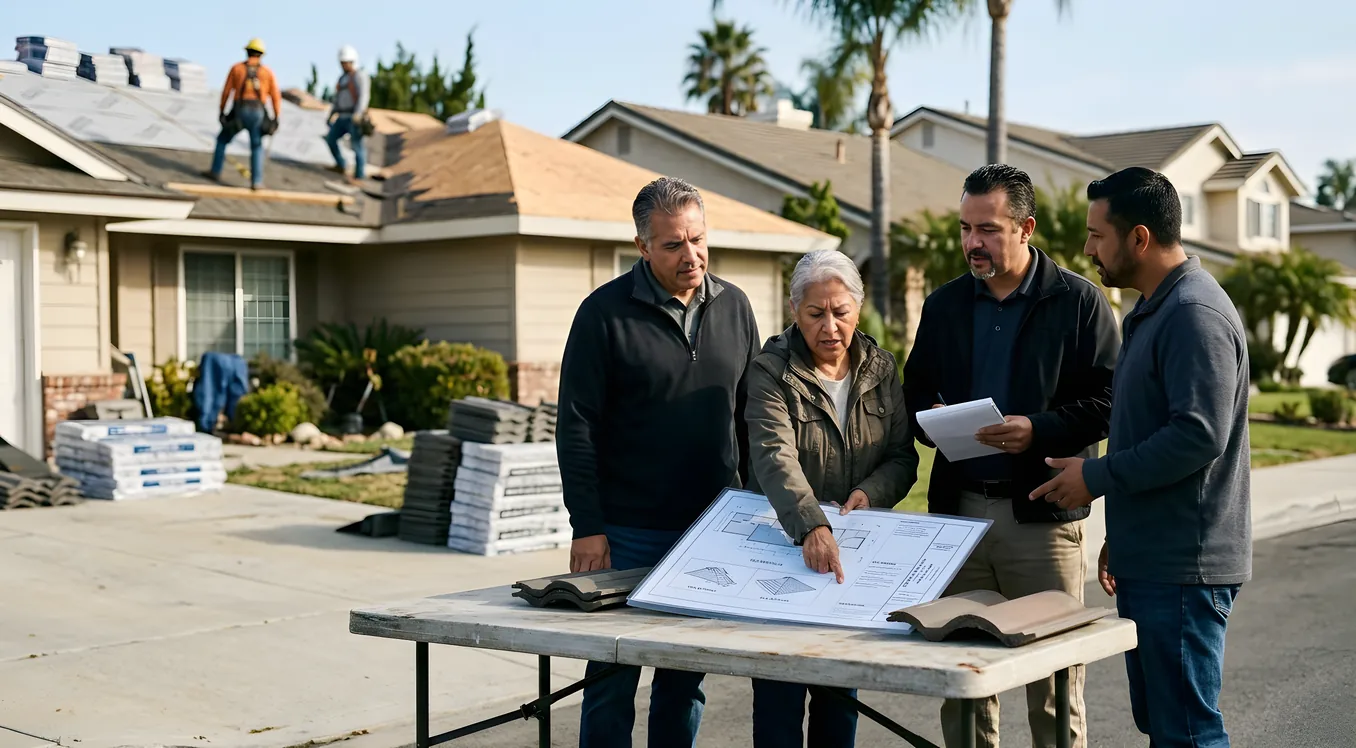
Getting a new roof approved in a Bay Area HOA takes more than picking out shingles. Before a single nail goes in, you need written approval from an Architectural Review Committee (ARC), a contractor packet that meets specific documentation requirements, and a clear answer to a question most homeowners skip entirely: is the roof even yours to pay for? We’ve worked with HOAs across Contra Costa, Alameda, and Solano counties since 1996, and here are the guidelines we’ve learned that actually move applications forward.
Who Actually Owns Your Roof?
For HOA roof replacement, the most important question is who is legally responsible for the roof in the first place. The answer depends on your property type and what your CC&Rs (Covenants, Conditions and Restrictions) say. Many Bay Area homeowners assume they own their roof simply because they own their home. That assumption can cost thousands.
| Property type | Who pays for roof replacement? | Who approves the work? |
|---|---|---|
| Single-family home in a planned community (PUD) | Homeowner | HOA / ARC (aesthetic rules + written approval required) |
| Detached condo | Homeowner (confirm in CC&Rs) | HOA / ARC |
| Attached townhome | Depends on CC&Rs. Roof may be “exclusive use common area” | HOA / ARC |
| Condo (multi-unit building) | HOA (common area per California Civil Code §4775 unless CC&Rs say otherwise) | HOA board |
Two rows in that table cause the most confusion in the communities we serve.
Attached townhomes: Many homeowners in Danville, Walnut Creek, Alamo, and Pleasanton are paying out of pocket for work that may legally be the HOA’s responsibility. Pull your CC&Rs and read the definitions of “separate interest” and “exclusive use common area” before you spend a dollar. California Civil Code §4775 places the maintenance and replacement cost on the HOA for common area roofs unless the CC&Rs explicitly state otherwise.
Condos in multi-unit buildings: If your roof is common area and the HOA has been collecting maintenance fees for years, ask questions before writing a check. The HOA’s master policy should cover it.
What California Law Actually Says About HOA Roof Replacement
The Davis-Stirling Act governs every HOA community in California, from a small condo complex in Orinda to a 2,000-home planned development like Blackhawk. California Civil Code §4000 et seq. establishes the floor for how HOAs can operate statewide, and no other state’s law applies here. California has approximately 51,250 HOA communities serving over 14.4 million residents. Every single one operates under Davis-Stirling.
ℹ️ California Law on ARC Denials
Civil Code §4765 requires every ARC denial to be in writing, cite the specific CC&R rule violated, and include appeal instructions. A vague letter citing "aesthetics" with no rule reference is legally insufficient. Know this section number before you submit.
The sections that matter most for a roof replacement:
Civil Code §4765 requires the ARC to maintain a “fair, reasonable, and expeditious” approval process. Any denial must be in writing, must cite the specific rule violated, and must include instructions for how to appeal. A vague letter citing “aesthetics” without pointing to a specific CC&R provision is legally insufficient. That matters if you ever need to push back.
Civil Code §4775 establishes that the HOA is responsible for maintaining and replacing common areas, including roofs, unless the CC&Rs say otherwise. Read your documents.
Civil Code §4720 protects fire-resistant roofing materials from HOA prohibition. HOAs in California cannot block Class A fire-rated products: clay tile, concrete tile, metal, and Class A asphalt shingles from manufacturers like GAF and CertainTeed cannot be denied on fire safety grounds. This matters in Contra Costa and Alameda hillside communities where fire risk is high and HOAs have been tightening their materials lists.
The law gives homeowners real tools. Knowing the section numbers before you submit an ARC application puts you in a better position if anything goes sideways.
How HOA Roof Approval Actually Works
The ARC approval process follows predictable steps. Budget 4-8 weeks for the review alone, separate from permits and contractor scheduling. Most boards meet monthly, so submitting right after a meeting means waiting for the next agenda slot.
⭐ Plan Ahead of Rainy Season
ARC approval alone runs 30-60 days in most Bay Area communities. Add contractor scheduling, permit lead times, and any solar coordination, and a roof replacement that feels urgent in October may not start until January. Submit your ARC application by August if you want the work done before the rains arrive.
-
Pull your CC&Rs and architectural guidelines before calling anyone. The HOA is legally required to provide these documents. Most post them on the management portal; if not, request them in writing.
-
Contact the HOA management company and request the current ARC application form and the approved materials list. Many Bay Area HOAs maintain a list of pre-approved shingle colors and product lines. Getting this list before you pick materials saves a rejection.
-
Assemble your application packet. See the next section for exactly what goes in it.
-
Submit to the ARC before any work begins. Some communities require 30 days notice; others want 60. Check your specific guidelines.
-
Wait for written response. Under Civil Code §4765, the ARC must respond within a reasonable time. Most bylaws specify 30-45 days. Silence is not approval for a roofing application. If the deadline passes without a response, follow up in writing.
-
Get approval in writing with the letter specifically referencing your submitted materials and drawings by date, before scheduling the contractor.
-
If denied: See the dispute section below. The HOA may already have a list of preferred roofing contractors they want you to contact, and those companies may offer discounts you would not otherwise receive. But if the denial is based on a rule the letter does not actually cite, you have grounds to push back.
What Your Contractor Packet Needs to Include
A complete HOA roofing application requires more than a professional estimate. Here is what Bay Area ARC committees want to see. The details matter because they allow the ARC to compare estimates line by line and verify code compliance before approving any work.
💡 What a Complete ARC Packet Includes
Every Bay Area ARC application should have: C-39 license number (verified at contractors.cslb.ca.gov), a COI with matching named insured and a current expiration date, manufacturer spec sheets with fire rating and color chip numbers, physical color samples (not just digital images), and a project timeline with confirmed work hours. Missing any one of these is the most common reason packets come back rejected.
A complete packet includes:
CSLB C-39 license verification. C-39 is California’s required roofing contractor classification. The California Contractors State License Board publishes a public lookup at contractors.cslb.ca.gov. Verify any contractor’s license number there before you include it in the application.
Certificate of Insurance (COI). Minimum $1,000,000 general liability per occurrence plus active workers’ compensation coverage. The named insured on the COI must exactly match the company name. Check the expiration date. Many ARC applications are rejected on COI technicalities alone.
Manufacturer specification sheets. GAF and CertainTeed both publish these publicly. The ARC wants fire rating, weight, profile, and color chip numbers. Include the full spec sheet, not just the product name.
Physical color samples or printed swatches matching the community’s approved palette. Many ARC committees reject applications that include only a digital image.
Project timeline and work hours confirming compliance with the community’s noise ordinance.
A contractor who has already worked in Blackhawk, Danville, San Ramon, or Alamo likely knows what the ARC approves before you even submit. That institutional knowledge can cut weeks off your timeline. Contractors who have submitted packets in your neighborhood already know how to work with the HOA, which speeds things up.
If You Have Solar Panels on That Roof
Replace the roof first, then reinstall the panels. Replacing a roof under an active solar system adds significant labor cost and scheduling complexity that is easy to avoid with a little planning.
⚠️ Don’t Schedule Solar and Roof Separately
Solar removal and reinstallation adds 60-90 days of coordination on top of ARC approval and contractor scheduling. Book the solar company at the same time you submit your ARC application, not after you get approval. Homeowners who sequence these steps wrong end up with weeks of unnecessary delays and roof paper exposed to weather.
The Solar Rights Act prevents HOAs from placing unreasonable restrictions on solar energy systems. California Civil Code §714 defines “unreasonable” precisely: any HOA restriction is void if it adds more than $1,000 to the installation cost or reduces expected electricity output by more than 10%. Aesthetic objections alone cannot cross those thresholds.
Civil Code §714.1 addresses your own roof specifically: you are responsible for the cost of removing and reinstalling your panels when roof work is required. Budget 60-90 days of coordination time for solar removal and reinstallation. Start that coordination when you submit your ARC application, not after approval. The wait times overlap usefully.
Civil Code §4746 covers condo owners specifically. If you are in a condo, you have the right to install solar panels on your pro-rata share of the common area roof. The HOA can require maintenance agreements and insurance documentation, but cannot simply deny the application.
Pacific Coast Roofing Service does not install solar, but we coordinate the timing so panels come off before tear-off and go back on after the final inspection. We have done this many times and it saves homeowners significant rescheduling headaches.
When the HOA Says No
A denial is not the end of an HOA roof replacement dispute. California law gives you a structured escalation path, and most Bay Area HOA disputes resolve well before litigation.
-
Request written rationale. Civil Code §4765 requires the denial to cite specific rules. If the letter is vague, respond in writing asking for the exact CC&R provision or architectural guideline relied on. This creates a paper trail and often produces a more reasoned response the second time.
-
Request full-board reconsideration. If the ARC is a subcommittee rather than the full board, you have the right to request open-meeting reconsideration. Bring your contractor, material samples, and a point-by-point response to each stated reason for denial. This is also the right setting for the scenario where the HOA says you need full replacement but a licensed C-39 contractor’s assessment shows the deck is sound and matching shingles are all that is needed. Bring the contractor to the board meeting with that assessment in writing.
-
File for Internal Dispute Resolution (IDR). The Davis-Stirling Act requires every California HOA to have an IDR procedure, sometimes called “meet and confer.” Request it in writing. The HOA must participate. There is no fee charged to the homeowner.
-
Mediation under Civil Code §5930. Before filing any civil lawsuit over an HOA dispute, both parties are required to attempt Alternative Dispute Resolution (ADR). Many counties offer low-cost mediation through community dispute resolution centers. Less adversarial than the name suggests.
-
Small claims or civil court. For disputes under $12,500, small claims court is available without an attorney.
One note: the California Department of Real Estate handles complaints about HOA managers for licensing violations and fraud. It is not an enforcement body for ARC material disputes, but if you believe your HOA manager is acting outside their license, that is the right channel.
Bay Area HOA Roofing: What to Expect in the Communities We Serve
Planned communities in Contra Costa and Alameda counties have well-established ARC processes with published shingle lists and color palettes. A contractor who has submitted packets to these communities already knows what passes review.
In Danville, San Ramon, Alamo, and Blackhawk, ARC committees tend to be detailed and organized. Expect requests for physical samples rather than digital swatches, and prepare for specific color-code matching against published palettes. In Walnut Creek and Orinda, hillside communities are increasingly requiring Class A fire-rated materials even where state code would allow lower-rated products. Wood shake is off most active approval lists in these areas. In Pleasanton, post-pandemic compliance enforcement is active: HOAs that deferred maintenance letters during COVID are now sending them. These are not demands to use a specific contractor. Homeowners retain contractor choice as long as the work meets the guidelines.
One consistent pattern across all of these communities: the HOAs that know a contractor’s name move faster. Pacific Coast Roofing Service has been doing roof replacement work in these neighborhoods since 1996. When we submit a packet, the committee recognizes the license number.
We’ve handled HOA submission packets across the Bay Area since 1996. Call us at (510) 912-5454 and we’ll walk you through what your specific community requires before you submit anything.
Frequently Asked Questions
Does my HOA pay for my roof replacement?
It depends on your property type. In a condo building, the roof is typically common area and the HOA’s financial responsibility under California Civil Code §4775. For single-family homes and most townhomes in planned communities, the homeowner pays. Read your CC&Rs before spending anything: look for how “separate interest” and “exclusive use common area” are defined.
Can the HOA force me to replace my roof?
Yes, if your CC&Rs authorize enforcement of maintenance standards. But you have rights. You can request a second opinion from a licensed C-39 roofer, and if a contractor determines that repairs rather than full replacement are warranted, bring that assessment to the HOA board with a formal written request for reconsideration. Get everything in writing.
How long does HOA roof approval take in the Bay Area?
Budget 4-8 weeks minimum. HOA boards typically meet monthly, so submitting right after a meeting means waiting for the next agenda slot. California Civil Code §4765 requires a fair and expeditious ARC process, and most bylaws give the committee 30-45 days to respond. Silence is not approval for a roofing application.
What if the HOA denies my roofer or materials?
The denial must be in writing and cite the specific CC&R provision or rule violated. Vague denials citing “aesthetics” without specifics are legally insufficient under Civil Code §4765. Your escalation path: request written rationale, request full-board reconsideration, file for Internal Dispute Resolution (IDR), then mediation under Civil Code §5930.
Do I need HOA approval for both a roof replacement and solar panel installation?
Yes, and timing matters. Submit your ARC application for the roof first, then start coordinating solar panel removal at the same time. Under California Civil Code §714.1, you pay for panel removal and reinstallation on your own roof. Under the Solar Rights Act (Civil Code §714), the HOA cannot impose restrictions that add more than $1,000 to your solar installation cost or reduce output by more than 10%.
Call Pacific Coast Roofing Service Before You Submit Anything
Pacific Coast Roofing Service has been working with Bay Area HOAs since 1996. As GAF Certified Applicators, that certification matters to ARC committees specifically: when they ask about warranty validity and manufacturer credentials, GAF certification answers the question directly and keeps the application moving. We put together the full application packet: the material specs, the COI, the color samples, the timeline, everything the ARC needs. We have done this across Danville, Walnut Creek, Pleasanton, and dozens of other HOA-heavy communities in Contra Costa and Alameda counties.
🎯 We Know What Your ARC Wants
Pacific Coast Roofing Service has been submitting HOA packets in Danville, San Ramon, Walnut Creek, Pleasanton, and Orinda since 1996. We put together the full packet: C-39 verification, COI, spec sheets, and physical color samples, all ready for first-submission approval. Call (510) 912-5454 before you submit anything.
Call (510) 912-5454. We are available Monday through Friday 7 AM to 6 PM and Saturday 9 AM to 3 PM.