
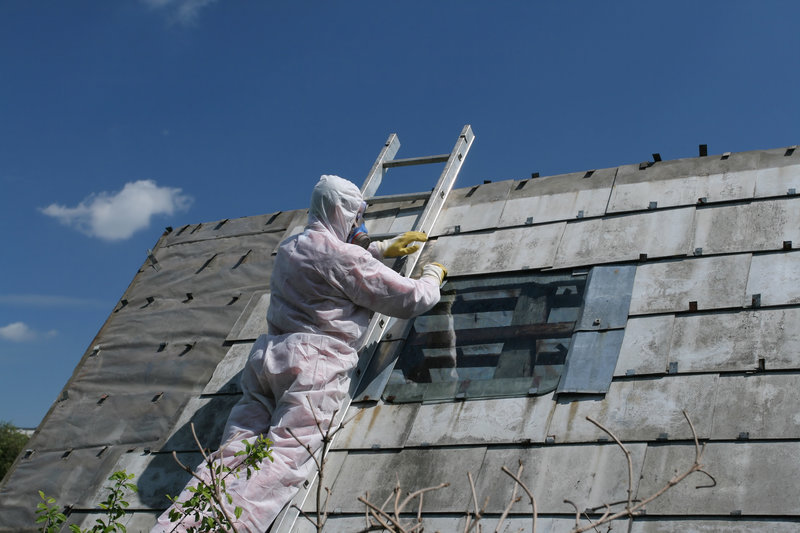
If your Bay Area home was built before 1980, there is a real chance the roof contains asbestos. The East Bay cities of Oakland, Berkeley, Alameda, Richmond, El Cerrito, and Kensington have some of the oldest housing stock in the region, much of it built during the post-WWII building boom of 1945 to 1975, when asbestos was standard in construction materials. Asbestos appears in four places on pre-1980 roofs: the cement shingles themselves, the felt underlayment beneath them, the mastics and sealants around flashings and pipe penetrations, and corrugated transite panels on garages and carports. An intact, undisturbed asbestos roof poses limited immediate risk. A roof reaching end of life is no longer intact. California law requires a licensed abatement contractor to handle removal. A separate roofing contractor handles the new installation. Pacific Coast Roofing Service handles the replacement side, coming in after abatement is complete. This post explains how the entire process works, what it costs in the Bay Area, and what California regulations require that no other state does.
Does Your Bay Area Home Have an Asbestos Roof?
The four materials that contain asbestos in pre-1980 roofs
Age alone does not confirm asbestos. These four material types are where it actually hides.
Cement-asbestos shingles are the most common form. They are flat rectangular shingles, roughly 12 by 24 inches, heavier than wood, with a chalky matte grey or grayish-blue finish, a scalloped bottom edge, and two nail holes near the top. Made from Portland cement and asbestos fiber, they were installed on Bay Area homes from the late 1930s through the mid-1970s. Asbestos content typically runs 10 to 15 percent by weight. They are sometimes mistaken for modern fiber-cement products, but modern fiber-cement does not contain asbestos.
Transite panels are asbestos-cement products formed into corrugated or flat sheets. Originally a trade name, “transite” is now used as a generic term for all asbestos-cement panels. You see them most often on garages, carports, and older detached structures throughout the East Bay. A corrugated profile and weathered grey-green color are the visual identifiers.
Roofing felt (underlayment) is asbestos-reinforced tar paper installed under the finish roofing layer as a moisture barrier. It is not visible without removing the top layer. In 30+ years of replacing pre-1980 Bay Area roofs, one of the more common surprises is what shows up once the shingles come off: felt underlayment that also requires abatement treatment. Homeowners expecting a straightforward replacement sometimes find out there is more asbestos-containing material (ACM) present than the visible surface suggested.
Mastics and sealants are the tar-like compounds used around flashings, chimney bases, pipe penetrations, and nail holes. Often black or grey, they could contain chrysotile asbestos at concentrations of 10 to 30 percent. They are easy to overlook because they do not look like roofing material. Vent pipe flashings and pipe jacks are also worth noting: the asbestos-reinforced flashing material itself, or the mastic applied around the collar, can contain ACM at similar concentrations.
Visual clues and why they are not enough
The chalky texture, heavy weight, scalloped edge, and home age are all indicators worth noting. None of them confirm asbestos. The California Department of Public Health states it plainly: the only way to know for sure if a material contains asbestos is to have it tested by a laboratory. Visual inspection is not sufficient, and no roofing contractor can confirm asbestos content by looking at the material.
⚠️ California Requires Lab Testing, Not Visual Inspection
The California Department of Public Health is direct on this point: the only way to confirm whether a material contains asbestos is laboratory analysis. Visual inspection is not sufficient and cannot substitute for PLM testing. Any contractor who tells you they can identify asbestos by looking at your shingles is giving you information they cannot support.
How a Certified Asbestos Consultant confirms it with PLM testing
Confirmation requires a pre-renovation survey by a Certified Asbestos Consultant (CAC), a professional certified by Cal/OSHA’s Division of Occupational Safety and Health (DOSH). The CAC collects bulk samples from suspect materials: shingles, felt, mastics, and flashings. Those samples go to an NVLAP-accredited laboratory for analysis by Polarized Light Microscopy (PLM), the only EPA-approved method for identifying asbestos in bulk materials. Results typically come back in 24 to 72 hours. The Bay Area Air Quality Management District (BAAQMD) requires this pre-renovation survey before any demolition or renovation that could disturb asbestos-containing material. Skipping the survey is a violation in itself, regardless of whether asbestos is ultimately found.
Is It Safe to Live Under an Asbestos Roof?
The answer turns on one distinction: friable versus non-friable.
A friable material is one that crumbles under hand pressure, or one that has been or will be rendered crumbly during removal. Non-friable material, like intact cement-asbestos shingles or transite panels in good condition, is classified as Category II ACM. In that state, it is not classified as Regulated ACM (RACM), the threshold that triggers full abatement requirements.
An intact, undisturbed asbestos roof in good structural condition poses lower immediate risk than one that is cracked, weathered, actively deteriorating, or about to be removed. The risk comes from fiber release, not from passive presence.
When to act now versus monitor: any visible cracking, surface erosion, or physical damage means act now. Any planned renovation or removal means act now. A roof that has reached end of life is, by definition, deteriorating. There is no point in repairing an asbestos roof. The risk is too high, and a 40-plus-year-old asbestos roof is in need of replacement regardless of the asbestos question.
Two points worth keeping in mind. First, the EPA recognizes no safe level of asbestos exposure for disturbed fibers. Second, asbestos-related diseases, including mesothelioma, have a latency period of 20 to 50 years between exposure and symptom onset. The International Agency for Research on Cancer (IARC) identifies asbestos as a cause of mesothelioma and cancers of the lung, larynx, and ovary. The risk is real even if it is not immediate in the intact-roof scenario.
Encapsulate or Replace? What California Homeowners Need to Know
Encapsulation means applying a sealant to lock fibers in place rather than removing the material. For intact Category II ACM in good structural condition that does not need to be disturbed, encapsulation can be a legitimate option. It is primarily used on stable material in interior or inaccessible locations where removal would cause more disruption than it prevents.
For a roof being replaced, encapsulation is not the answer. The roof is coming off. Once removal is required, abatement is required. There is no encapsulation pathway that avoids the abatement process when the material is being disturbed.
For end-of-life roofs, replacement is the right call. Encapsulation buys time on stable material. It does not extend a failing roof’s lifespan, and it does not apply when the material is coming off anyway.
California Regulations for Asbestos Roof Removal
This is where Bay Area asbestos roof projects differ from every other state. Three overlapping regulatory bodies govern the work. Zero of the national roofing sites that rank for this topic name any of them.
| Regulatory Body | Standard | What It Controls |
|---|---|---|
| BAAQMD | Regulation 11 Rule 2 | Air quality notification, J# permit, 9-county enforcement |
| Cal/OSHA | 8 CCR 1529 | Worker safety, wet removal methods, contractor DOSH registration |
| CSLB | C-22 classification | Contractor licensing for 100+ sq. ft. ACM jobs |
BAAQMD Regulation 11 Rule 2 and the J# requirement
The Bay Area Air Quality Management District enforces air quality rules for asbestos demolition and renovation in all nine Bay Area counties, covering Contra Costa, Alameda, Solano, and the surrounding region. BAAQMD developed its own asbestos regulation in 1976, predating federal NESHAP (National Emission Standards for Hazardous Air Pollutants) for residential applications.
ℹ️ BAAQMD Developed Its Asbestos Rules in 1976
The Bay Area Air Quality Management District created its own asbestos demolition and renovation regulation in 1976, predating federal NESHAP requirements for residential applications. That means Bay Area projects operate under rules that are stricter and more specific than what most national roofing cost guides account for. If you are comparing quotes or timelines from out-of-area sources, the regulatory steps described here are local requirements that apply regardless of what you read elsewhere.
The notification threshold under Regulation 11 Rule 2 is 100 square feet, 100 linear feet, or 35 cubic feet of Regulated ACM. Nearly every residential roof replacement in the Bay Area exceeds this threshold.
Before work begins, the project must be filed through BAAQMD’s MyAirOnline portal. No phone submissions, no paper submissions. Standard projects require 10 business days notice minimum. For residential buildings of four or fewer units, a 72-hour expedited option exists with an additional fee.
After filing, BAAQMD issues a J# (job number). That J# must be posted on-site before work begins. The start and end dates in the J# are confirmed commitments, not estimates. Failure to update the J# by 11:59 PM of the start date is a violation. This is not a technicality: inspectors check for posted J#s on active abatement sites.
Cal/OSHA 8 CCR 1529: what it requires of workers and contractors
California’s primary occupational safety standard for asbestos roofing work is Cal/OSHA 8 CCR 1529. Roofing removals are classified as Class II asbestos work under this standard.
Key field requirements: materials must be removed in an intact state where feasible. Wet methods are required throughout the removal process to suppress airborne chrysotile fiber release. Materials cannot be thrown to the ground. They must be passed down by hand, hoist, or covered chute, then immediately bagged or placed in covered containers. Workers must complete at least 8 hours of initial training for Class II roofing work. Contractors working on 100 square feet or more of ACM must be registered with Cal/OSHA’s DOSH division, which maintains a searchable Asbestos Registrants’ Database.
CSLB C-22: the license homeowners need to ask for
Any contractor performing asbestos abatement on 100 square feet or more of ACM must hold the C-22 classification from the California Contractors State License Board (CSLB). The CSLB will not issue a C-22 without proof of DOSH registration. These credentials are linked.
⚠️ DIY Asbestos Removal in California: What the Law Still Requires
Owner-occupants of single-family homes may legally perform their own ACM removal in California. The regulatory steps do not go away: you still need a pre-renovation CAC survey, BAAQMD J# notification filed through MyAirOnline, NVLAP-accredited PLM testing, proper double-bagging in labeled 6-mil poly bags, and a registered hazardous waste transporter for disposal. BAAQMD strongly discourages DIY removal. The steps that add cost are the required regulatory steps, not the contractor labor.
A general roofing contractor with a C-39 license cannot legally handle the asbestos removal portion of the job. C-39 and C-22 are separate contractor classifications. The roofing license does not cover abatement work.
Homeowners who occupy their own single-family residence are not legally required to hold a C-22 to do their own removal. But the pre-renovation CAC survey, BAAQMD J# notification, NVLAP-accredited lab testing, proper double-bagging, and a registered hazardous waste transporter for disposal all still apply. BAAQMD strongly discourages DIY removal. The liability exposure and health risk make it a poor tradeoff for most homeowners.
Before signing any abatement contract, ask for the contractor’s C-22 number and DOSH registration and verify both are current. While you are at it, review the questions to ask your roofing contractor before signing anything.
What Does Asbestos Roof Replacement Cost in the Bay Area?
This project has two separate cost phases. Most cost guides present a single number. In the Bay Area, the structure is abatement first, new roof second. Both phases cost money.
⭐ Bay Area Asbestos Roof Replacement Has Two Separate Cost Phases
Abatement comes first and is a separate cost from the new roof. Abatement alone runs $16,000 to $40,000 for a typical Bay Area home, handled by a licensed C-22 abatement contractor. The roofing installation is a separate contract that begins only after abatement is complete and clearance documentation is in hand. National cost estimates that present a single blended number do not reflect how this work is structured in California.
Phase 1: Abatement. The pre-renovation CAC survey runs $245 to $800. The abatement work itself ranges from $50 to $150 per square foot for exterior roofing projects. For a typical Bay Area home with roughly 2,000 square feet of roof, that puts abatement costs between $16,000 and $40,000 before the roofing contractor arrives. Bay Area prevailing wages and certified disposal facility fees push costs well above national averages. National figures of $2,200 to $3,000 for “asbestos removal” reflect partial or small interior jobs, not full roof replacements in Contra Costa, Alameda, or Solano County.
The final cost depends on how many material types require abatement. Shingles only is one scenario. Shingles plus felt underlayment plus mastics around flashings is a more expensive one. Accessibility and disposal facility fees also affect the final number.
DIY does not save money on abatement in any meaningful way. The CAC survey, J# notification, NVLAP-accredited lab testing, disposal manifests, and registered hazardous waste transporter are all required whether you do the physical removal yourself or hire a contractor. The steps that add cost are the regulatory requirements, not the labor.
Phase 2: New roof installation. This is PCR’s portion of the project. It begins only after abatement is complete and clearance documentation is in hand. Standard replacement costs apply at that point, based on roof size, material choice, and condition of the decking.
Resale value. Replacing an asbestos roof before listing removes the California disclosure burden and typically produces better offers than leaving the issue for the buyer to find during inspection. Seller credits buyers demand on asbestos discoveries tend to exceed what replacement would have cost.
The Asbestos Roof Replacement Process, Step by Step
Asbestos roof replacement in California requires a licensed abatement contractor with a CSLB C-22 classification, a pre-renovation survey by a Certified Asbestos Consultant, and a J# notification filed with the Bay Area Air Quality Management District before any work begins. The full sequence has ten steps that cannot be reordered.
-
Pre-renovation asbestos survey. A Certified Asbestos Consultant inspects the roof and collects bulk samples from suspect materials: shingles, felt, mastics, and flashings. The survey report documents all ACM locations and quantities.
-
PLM laboratory testing. Samples go to an NVLAP-accredited laboratory for Polarized Light Microscopy analysis. PLM is the only EPA-approved method for confirming asbestos content in bulk materials. Results typically take 24 to 72 hours.
-
BAAQMD J# notification. If removal exceeds the threshold (100 sq ft, 100 linear ft, or 35 cubic ft of Regulated ACM), the project is filed through BAAQMD’s MyAirOnline portal. Standard residential projects require 10 business days minimum notice. The J# acknowledgment letter must be posted on-site before work begins.
-
Abatement contractor mobilization. A CSLB C-22 and Cal/OSHA DOSH-registered abatement contractor sets up containment: 6-mil polyethylene sheeting, negative-air-pressure HEPA units, and a decontamination zone for workers entering and exiting the work area.
-
Wet removal. Roofing materials are removed in intact state where feasible, kept continuously wet per Cal/OSHA 8 CCR 1529 to prevent chrysotile fiber release. Nothing is thrown to the ground. Materials pass down by hand, hoist, or covered chute.
-
Bagging and labeling. All removed ACM and contact materials, including PPE and tools, are double-bagged in 6-mil poly bags and labeled with proper hazardous waste markings.
-
HEPA cleanup. The work area is HEPA-vacuumed. Air clearance testing may be required depending on project scope.
-
Hazardous waste transport. A registered hazardous waste transporter hauls all ACM to a permitted landfill authorized by DTSC and the Regional Water Quality Control Board. A Uniform Hazardous Waste Manifest travels with every load.
-
Clearance documentation. The abatement contractor provides project completion documentation. J# start and end dates are confirmed met, or properly updated if the schedule changed.
-
New roof installation. This is where Pacific Coast Roofing Service enters. With abatement complete and clearance in hand, PCR proceeds with standard replacement: decking inspection, underlayment, and new shingles or tile.
Steps 1 through 9 require a licensed asbestos abatement contractor with C-22 and DOSH credentials. PCR does not perform asbestos abatement. PCR handles Step 10 and coordinates with the abatement firm on timing, so homeowners have one point of contact for the project rather than managing two separate contractors and two separate schedules.
Replacement Material Options for Bay Area Homes
Once abatement is complete and clearance is issued, the new roof is a standard replacement project. Material options for Bay Area homes fall into two main categories.
🎯 Ready to Plan the Replacement Side?
Pacific Coast Roofing Service handles the new roof installation after your abatement contractor clears the site. We coordinate timing with the abatement firm so you have one point of contact from clearance through final installation. Free replacement assessment for pre-1980 Bay Area homes. We serve El Sobrante, Richmond, Berkeley, Oakland, Hayward, Concord, and surrounding communities.
Asphalt shingles are the most common choice. They are the lowest-cost option, widely available, and well-suited to the Bay Area’s climate. Pacific Coast Roofing Service is a GAF Certified Applicator, a manufacturer credential that affects warranty terms on GAF products. GAF and CertainTeed shingles are both available.
Concrete tile offers a longer lifespan and suits homes that originally had a tile-style roof profile. It is heavier than asphalt and requires a structural assessment to confirm the decking can support the added weight.
The material decision is straightforward once abatement is done. PCR can walk through the options based on your home’s original profile and your budget at the time of the replacement assessment.
Selling a Home With an Asbestos Roof in California
California Health and Safety Code Section 25915 requires disclosure of asbestos-containing materials to prospective buyers in certain contexts. An undisclosed asbestos roof is a material fact. Leaving it undisclosed creates liability.
In practice, listing with a known asbestos roof in Contra Costa, Alameda, or Solano County typically draws lower offers or buyer-requested seller credits that exceed what abatement plus replacement would have cost. Replacing before listing removes the disclosure requirement and removes the buyer’s ability to demand a credit on it.
If your home is in an HOA, review the HOA roof replacement rules in California before scheduling work, as HOA requirements may affect your material options or timeline.
For guidance specific to your sale situation, speak with a real estate attorney. Disclosure requirements can vary based on property type and transaction structure.
Frequently Asked Questions
How much does it cost to replace a roof with asbestos in the Bay Area?
The abatement phase alone, before a single new shingle is installed, runs $16,000 to $40,000 for a typical Bay Area home. The abatement work itself is $50 to $150 per square foot, plus $245 to $800 for the pre-renovation CAC survey. The new roof installation is a separate cost on top of abatement. Bay Area prevailing wages and certified disposal facility fees push total project costs well above national averages.
Is it safe to live under an asbestos roof?
Intact, undisturbed asbestos roofing in good condition poses lower immediate risk than damaged or deteriorating material. The regulatory distinction is friable versus non-friable: intact cement-asbestos shingles are Category II ACM and are not classified as Regulated ACM when undisturbed. The risk rises sharply when materials are cracked, weathered, or about to be removed. The EPA recognizes no safe level of asbestos exposure for disturbed fibers.
Can I remove my own asbestos roof in California?
California law allows owner-occupants of their own single-family residence to remove ACM themselves. All other requirements still apply: the pre-renovation CAC survey, BAAQMD J# notification, NVLAP-accredited lab testing, proper double-bagging, and a registered hazardous waste transporter for disposal. BAAQMD strongly discourages DIY removal. The practical cost savings are minimal once all required regulatory steps are followed correctly.
When were asbestos shingles banned?
Federal bans on new asbestos in roofing products took effect starting in 1978, with most construction applications phased out by the early 1980s. In May 2024, the EPA finalized a ban on all remaining chrysotile asbestos uses, covering new imports and manufacturing. That ban does not affect materials already installed in existing buildings. Pre-1980 roofs in the Bay Area still contain it.
Can you sell a house with asbestos roof tiles in California?
Yes, but California Health and Safety Code Section 25915 requires disclosure of asbestos-containing materials to prospective buyers in certain contexts. An undisclosed asbestos roof creates liability and typically results in lower offers or seller credits. Most sellers find it more cost-effective to replace before listing than to negotiate on the issue after it surfaces during inspection.
How do I know if my roof has asbestos?
Age is the first indicator: pre-1980 Bay Area homes are the primary risk group. Visual cues, including chalky matte grey shingles, scalloped edges, or corrugated transite panels on garages, suggest asbestos but cannot confirm it. The only confirmed way to identify asbestos-containing material in a roof is Polarized Light Microscopy (PLM) testing on bulk samples collected by a Certified Asbestos Consultant. Visual inspection of cement-asbestos shingles, transite panels, or roofing felt cannot confirm asbestos content.
Pacific Coast Roofing Service has been replacing pre-1980 Bay Area roofs since 1996. In that time, the company has handled the replacement side of asbestos roof projects across Contra Costa, Alameda, and Solano counties. PCR handles the new roof replacement after abatement is complete. The company coordinates timing with the abatement contractor so homeowners have one point of contact for the project from abatement clearance through final installation. PCR is a GAF Certified Applicator.
If you have a pre-1980 Bay Area home and want a free quote on the replacement portion of your project, call (510) 912-5454. PCR serves El Sobrante, Richmond, Berkeley, Oakland, Hayward, Concord, and surrounding communities throughout the Bay Area. The assessment is free and there is no obligation.