
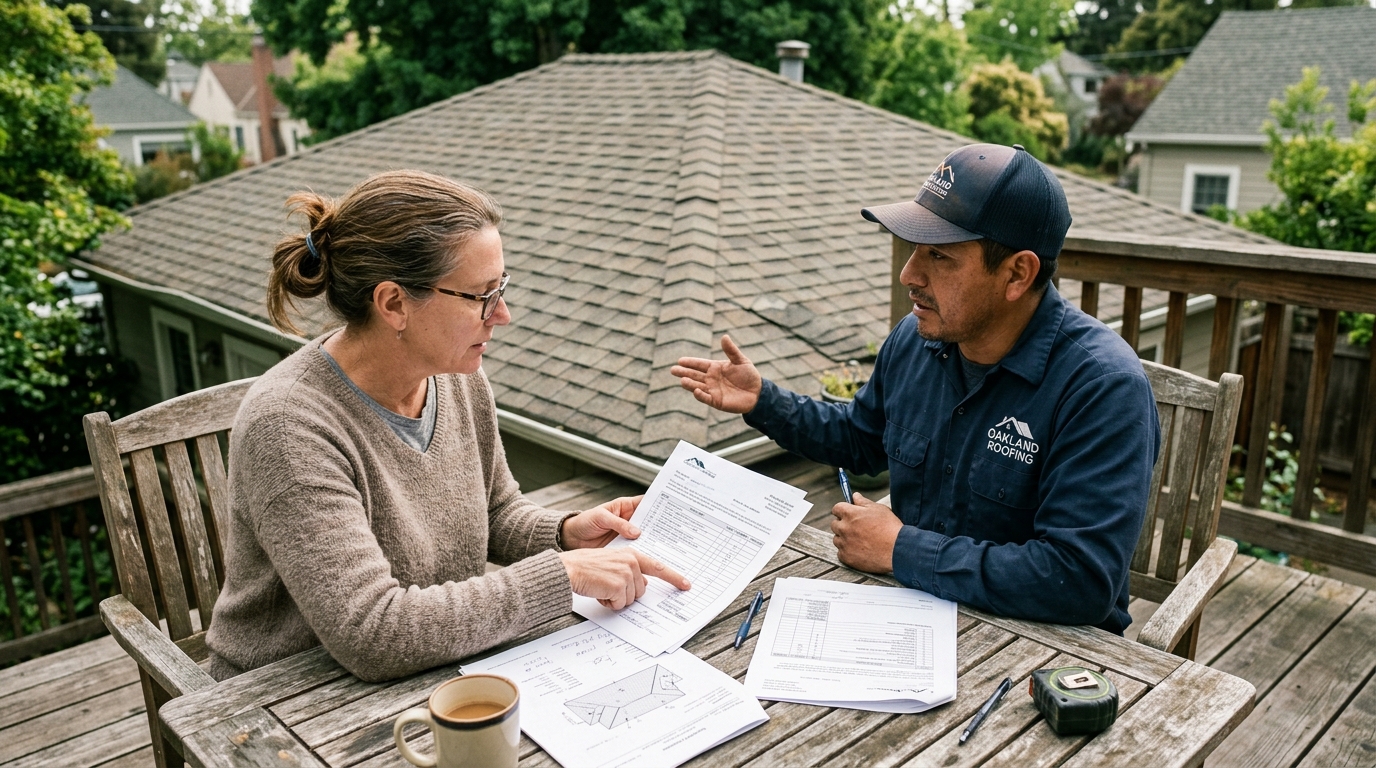
You receive three roofing estimates. One is $19,000. One is $26,000. One is $31,000. None of them explains why.
That’s the situation most Bay Area homeowners find themselves in, and it’s a frustrating one. You should only have to replace a roof every 15 to 25 years, so you want it done right this time. But three quotes with a $12,000 spread and no explanation is not a comparison you can trust.
The gap usually comes down to what each roofing estimate does or doesn’t include. Here’s what a complete roof replacement estimate must contain, and how to use that information before you sign anything.
What Your Roofing Quote Should Actually Tell You
A roofing quote that says “full roof replacement: $22,000” tells you almost nothing. It doesn’t say which materials were specified, whether the existing roof will be removed, whether a permit is included, or who is responsible for the deck damage that almost always shows up after tear-off.
An accurate roofing estimate is itemized. Every line item is a decision point. If a quote is missing one, that item is either being skipped or it’s showing up later as a change order after you’ve already signed.
Some of the variation between bids is legitimate: different measurement methods, different material grades, different warranty tiers. But a lot of it comes down to scope omissions. Knowing what to look for in a roofing estimate puts you in a position to ask the right questions before you commit.
The 8 Things Every Roofing Estimate Must Include
A trustworthy roofing estimate covers every system involved, not just the shingles on top.
1. Material Brand, Product Line, and Color
A roofing quote should specify the shingle manufacturer (GAF, CertainTeed), the exact product line, the color, and the quantity measured in roofing squares. One roofing square equals 100 square feet of actual roof surface, not floor plan square footage. “Asphalt shingles” is not a spec. A builder-grade 3-tab and a GAF Timberline HDZ are both asphalt shingles, and the price difference between them is real. The estimate should also specify underlayment type, drip edge material, and ice-and-water shield placement at eaves and valleys. Each of those is a separate line item, not a footnote.
2. Tear-Off vs. Overlay Decision
The quote must state whether the contractor will remove the existing roofing before installation (tear-off) or layer new shingles on top (overlay). California Building Code allows a maximum of two roofing layers. If your home already has two layers, a tear-off is legally required. An overlay saves money upfront but has a shorter lifespan, roughly 16 years versus 25 to 30 years for a full tear-off. Overlay also disqualifies the top manufacturer warranty tiers, including GAF Golden Pledge. A contractor proposing an overlay without confirming your current layer count has not done their homework.
3. Underlayment Type
Underlayment is the moisture barrier installed between the decking (the wood sheathing) and the shingles. An accurate roofing estimate specifies whether synthetic underlayment or traditional felt is being used. Synthetic is the current standard and performs better under Bay Area conditions. A contractor substituting felt without disclosing it is cutting a corner that won’t show up until long after the crew has left.
4. Flashing: Chimney, Step, and Pipe Boots
Every penetration through the roof is a separate flashing job: chimneys, skylights, plumbing vents, and HVAC curbs each need their own. The estimate should list each one. If your chimney isn’t named, it may not be in scope. Flashing omissions are one of the most common sources of surprise charges after signing. A complete estimate names step flashing, counter flashing, and pipe boot replacements individually.
5. Ventilation Plan
The estimate should describe how intake (soffit vents) and exhaust (ridge vent or power vents) will be handled. Many Bay Area homes built before 1980 have inadequate attic ventilation, and some jurisdictions require upgrades when a roof is replaced. If ventilation isn’t addressed in the estimate, it either won’t be done or it will be added to your bill after the fact.
6. Permit and Inspection Fees
A permit is legally required for complete roof replacements in most Bay Area cities. The permit fee should appear as a separate line item, not buried in a labor total. A contractor who says you don’t need a permit for a full replacement is either wrong or hoping you don’t know the difference. Unpermitted work creates problems at resale and can void an insurance claim.
7. Debris Disposal
Tear-off material has to go somewhere. The estimate should state whether disposal is handled via a dumpster on-site or haul-away by truck. When disposal is missing from the estimate, it frequently reappears as a separate invoice after the job starts.
8. Workmanship Warranty and Manufacturer Warranty
These are two separate documents covering two separate things. The manufacturer warranty (GAF, CertainTeed) covers material defects and is tied to the product line. The workmanship warranty is the contractor’s own guarantee on installation quality. Both should be stated in writing with term lengths spelled out. GAF’s Golden Pledge Limited Warranty, available only from GAF Master Elite contractors (the top 2% of U.S. roofers), provides 25 years of workmanship coverage and 50 years on materials. Those terms are not available from every contractor who bids your job.
Why Bay Area Roofing Quotes Vary by Thousands of Dollars
A $10,000 gap between the lowest and highest bid on the same house is not unusual in the Bay Area. Most of it comes from one of four places.
📊 Bay Area Roof Replacement Costs (2026)
$15,000 – $35,000
That is the typical range for a complete asphalt shingle replacement in Contra Costa and Alameda counties, or roughly $940 to $1,800 per roofing square depending on material grade and site conditions. A $30,000 quote on a standard Bay Area home is not overcharging. It is what complete scope costs.
Measurement method and pitch multiplier. Some contractors measure from the ground; others use satellite reports or walk the roof directly. The pitch multiplier is the single variable most homeowners never hear about. A steep 10/12-pitch roof has 30% more actual surface area than the floor plan suggests. A 6/12 pitch adds roughly 12%. Because roofing materials are priced per roofing square (100 sq ft of actual roof surface), a contractor estimating from floor plan dimensions instead of measured roof surface can be off by several squares before a single shingle is purchased.
Scope omissions. A quote without a permit line item, a decking allowance, or the full flashing scope will look cheaper because it is cheaper, until the change orders arrive.
Material grade. “Asphalt shingles” is a category, not a product. Underlayment alone can vary by $30 to $50 per square depending on whether the contractor is using felt or synthetic. Material grade differences between bids are sometimes more significant than the labor difference.
Labor overhead. A contractor running W-2 employees with workers’ comp coverage, company trucks, and general liability has real overhead. A contractor using unlicensed subcontractors with no benefits can undercut by 20 to 30%. The lower quote reflects who carries the risk if something goes wrong on your roof.
For a standard residential replacement in Contra Costa and Alameda counties, a complete asphalt shingle job in 2026 typically runs between $15,000 and $35,000. Per-square costs range from approximately $940 to $1,800 depending on material grade and site conditions. A $30,000 quote on a standard Bay Area home is not unusual and is not a signal of overcharging. The Remodeling Cost vs. Value Report consistently shows roof replacement among the highest-return exterior upgrades in the Pacific region.
For Oakland homeowners and Berkeley homeowners with the older, steep-pitched Craftsman and Tudor homes common in those markets, expect estimates toward the upper end of that range. Walnut Creek homeowners in newer developments with standard pitches often land in the middle.
Red Flags That Should Kill a Quote
A few things on a quote (or in a sales conversation) should stop you cold before you sign.
⚠️ Walk Away If You See Both of These
Cash-only payment with no written contract and a price that expires today are two separate red flags. When they appear together, do not negotiate. A $15,000 to $35,000 roof replacement deserves at least 48 hours to review the paperwork, and any contractor who disagrees is not the contractor you want on your home.
⚠️ California Law: Down Payment Cap
Under CA B&P Code §7159, a roofing contractor cannot legally require more than 10% of the contract price or $1,000 as a deposit before work begins, whichever is less. A demand for 30%, 50%, or full payment upfront is a violation of state law. If a contractor pushes back when you cite this, that tells you everything you need to know.
Lump-sum price with no itemized breakdown. “Full roof replacement: $18,500” tells you nothing. There is no way to evaluate this quote against another one.
No permit line item. If the estimate doesn’t show a permit fee, the contractor either isn’t planning to pull one or is hiding the fee. Either way, ask directly before signing.
No CSLB license number on the paperwork. Every California home improvement contract must include the contractor’s Contractors State License Board (CSLB) number. If it’s not there, the contract isn’t complete. Under CA B&P Code §7159, the CSLB number is a mandatory element of any written home improvement contract over $1,000.
Full payment or a large deposit required before work starts. California law caps the down payment at 10% of the contract price or $1,000, whichever is less (CA B&P Code §7159). Any contractor requiring 50% upfront before a nail is driven is in violation of California law.
An overlay proposed without examining the existing roof. A contractor who quotes an overlay without walking your roof or confirming the existing layer count does not know what they are bidding.
“Today only” pricing or pressure to sign before you’ve compared bids. A roof replacement is a $15,000 to $35,000 decision. Any contractor who can’t give you 48 hours to review is not one you want on your roof.
One more thing worth saying directly: when you see a sharp difference in labor costs, higher labor costs most likely reflect a company with W-2 employees, real insurance, and a company culture that takes care of its people. Our roofing laborers are incredibly hard workers, performing their jobs day in and day out in extreme conditions, almost regardless of weather and heat. The Bay Area is an expensive place to live, and we pay our employees higher than most, with excellent benefits. Hopefully, you feel that well-paid work is worth investing in. A crew of unlicensed subs costs less because someone else is carrying the risk if anything goes wrong.
Your Legal Protections as a California Homeowner
California gives homeowners meaningful protections in this process. Most homeowners don’t know about them.
💡 Use Your 3-Day Window
Under CA Civil Code §1689.6, you have 3 business days to cancel any home improvement contract after signing, no questions asked. Seniors get 5 days. The contractor is legally required to hand you a written cancellation form at signing. If they do not provide one, the cancellation period does not start. Read the full contract during those 3 days, not after.
Verify every contractor’s license before signing. Go to cslb.ca.gov and look up each contractor by name or license number. The lookup takes about 90 seconds and shows you license status (active, expired, or suspended), the C-39 roofing classification required for any California roofing job over $1,000, workers’ comp status, and any disciplinary actions. As of January 1, 2026, all C-39 roofing contractors must file proof of workers’ comp directly with CSLB. Workers’ comp class code 5552 covers residential roofing crews. If a contractor’s lookup shows “exemption” on a company with multiple employees, that’s worth a direct question.
Written contract required by state law. Under CA B&P Code §7159, any home improvement project over $1,000 requires a written contract that includes the contractor’s CSLB license number, a description of the work, start and estimated completion dates, a payment schedule tied to project milestones, and all warranty terms in writing. A contractor who asks you to sign a single-page order form without these elements is not in compliance with California law.
The 3-day right to cancel. Under CA Civil Code §1689.6, you have 3 business days to cancel any home improvement contract without penalty after signing. Seniors get 5 days. The contractor is legally required to provide a written cancellation form at signing. Use the cooling-off period. Read the contract. Have someone else read it too.
Mechanic’s lien awareness. Paying your contractor in full does not protect you if that contractor fails to pay their subcontractors or material suppliers. Those parties can place a mechanic’s lien on your home even after you’ve paid. Under California law, a subcontractor or supplier must serve a 20-day preliminary notice to preserve their lien rights. At final payment, ask for a conditional lien waiver from the general contractor and any documented subs. The CSLB publishes a free homeowner’s guide specifically on lien prevention.
If you want to compare questions to ask any roofing contractor alongside this checklist, that’s a useful next step.
What a Pacific Coast Roofing Quote Includes
The checklist above isn’t an abstract standard. It’s what Pacific Coast Roofing Service puts in every written estimate.
🎯 Get a Written Quote, Not a Ballpark
A phone estimate is not a number you can hold anyone to. Call (510) 912-5454 to schedule an on-site visit and receive a fully itemized written estimate covering every line item on this checklist. We walk through every line with you before you sign anything.
Our estimates name the material brand (GAF or CertainTeed), the product line, color, and quantity in roofing squares. They state whether we’re doing a full tear-off and list the per-sheet decking allowance for any replacement discovered after tear-off. Every penetration is scoped individually. The permit is a separate line item, not buried. Debris disposal is stated. Ventilation is assessed on every job, including soffit intake and ridge vent exhaust. Both warranty types, workmanship and manufacturer, appear in writing with their terms.
As GAF Certified Applicators, Pacific Coast Roofing Service can offer extended manufacturer warranty tiers that are not available from uncertified contractors. For qualifying homes, the GAF Golden Pledge Limited Warranty covers materials for 50 years and workmanship for 25 years. It requires a 40-point factory inspection of the completed roof by GAF itself. It is transferable when the home sells, which matters in a market where Bay Area homes in Walnut Creek, Danville, or Berkeley regularly list at $1M or more. That warranty is something a listing agent can put in the description.
CertainTeed SELECT ShingleMaster certification is our other verified credential for homeowners who prefer CertainTeed’s product line. Both certifications require ongoing training, verified insurance, and active license status.
Serving the Bay Area since 1996, we 100% believe that you get what you pay for. We don’t tell you to choose the highest bid. We tell you to choose the bid you know includes the highest-quality materials, labor, and craftsmanship. The structural integrity of your home depends on it.
Call (510) 912-5454 for a free estimate. We work 12 months a year across Contra Costa, Alameda, and Solano counties, and we’re happy to walk through every line of the quote with you before you sign.
You can also request a free estimate for new roof installation if you’re building or replacing on a structure without an existing roof.
Frequently Asked Questions
What should be included in a roofing estimate?
A complete roofing estimate should itemize the shingle brand, product line, and quantity in roofing squares; whether the job is a tear-off or overlay with the existing layer count stated; underlayment type; drip edge and ice-and-water shield placement; flashing at all penetrations; the ventilation plan; permit fees as a separate line item; debris disposal method; and both the workmanship warranty and manufacturer warranty in writing with their terms. A lump-sum price with no breakdown is not an estimate you can evaluate or compare.
What is the 25% rule in roofing?
The 25% rule is a general industry guideline: if the cost to repair your current roof exceeds 25% of what a full replacement would cost, replacement is typically the better investment. For a Bay Area home where replacement runs $20,000 to $25,000, that means repair costs over $5,000 to $6,000 start to tip the math toward a new roof. Factor in age and the remaining lifespan of the existing materials as well.
What’s the difference between a roofing quote and an estimate?
Most Bay Area contractors use the terms interchangeably. What matters is that either document is itemized in writing. A verbal quote or a single-line PDF is neither a quote nor an estimate worth comparing. If a contractor gives you a number without a written document, ask for the scope in writing before you consider it.
How long should a roofing quote take to receive?
After a proper on-site visit (30 to 45 minutes to walk the roof, assess pitch, count penetrations, and note any visible deck damage), 1 to 3 business days is standard for a written estimate. You should never feel pressured to sign during the visit itself. A contractor who leaves a quote and says it expires today is not operating in your interest.
What if the roofing quotes I received vary too much?
Ask each contractor to share their scope in writing, side by side. Most large variations come from different scope: one included the permit, one didn’t; one is doing a full tear-off, one is proposing an overlay; one included a ventilation upgrade, one didn’t mention it. If you’re comparing itemized quotes on identical scope and the gap is still large, ask the low bidder directly what they’re leaving out that the higher bid includes. The answer will tell you a lot.
Related guides
- The four biggest pricing factors in roofing: what actually drives the bottom-line number on your quote.
- 12 questions to ask a roofing contractor: the vetting questions that separate good contractors from bad.